
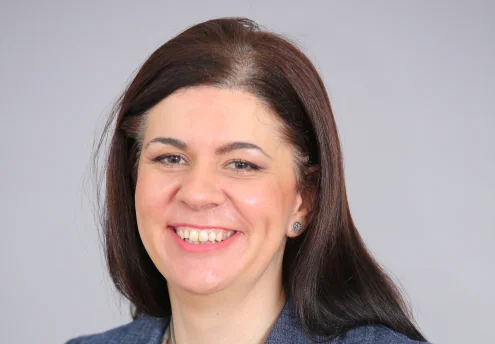
MDIF’s Program Director for Southeast Europe, Jelena Milosevic, was interviewed by Lideri održivosti (Leaders of Sustainability), a Montenegrin magazine published by MDIF client Vijesti. The interview spanned a wide range of topics including media’s role in promoting sustainability, AI’s influence on public interest media and media’s access to capital in the Western Balkans.
Here is a translated version of the interview:
We may have the best strategies, investments, and climate goals, but someone has to explain what is being done, check the results, and ask the uncomfortable question when something isn’t working. That is precisely where media become part of the infrastructure of a sustainable society.
MDIF’s Program Director for Southeast Europe, Jelena Milošević, talks about why media sustainability is not just a matter of finances, why the capital is important, especially in small markets and how the business models, technology and our understanding of what we call media today are changing.
When we are talking about sustainability, the first thing that comes to mind is energy, environment or responsible business practices. Why should media be part of that story, too?
Because no society can seriously talk about sustainability if its citizens don’t have reliable information on which to base their decisions. We can have the best strategies, investments, and climate goals, but someone has to explain what is being done, check the results, and ask the uncomfortable question when something isn’t working. That’s where media become part of the infrastructure of a sustainable society.
You’ve spent practically your entire career in media. Is there more talk about sustainability today than before?
Much more. When I was starting out, no one came to a meeting and said, “Let’s talk about sustainability.” We talked about sales, circulation, ratings, advertisers, new products, competition. But looking back today, I realize we were actually talking about the same question the whole time: how do you build a media outlet that’s relevant to its audience and enough of a good business to last?
What has changed is how much more complicated that is today. At one point you at least knew fairly well who your competitors were and where most of your revenue came from. Today you’re competing with the entire internet for audience attention, a large share of advertising ends up with global platforms, audience habits are changing at enormous speed, and now artificial intelligence is opening up a whole new round of questions.
In our markets there’s another factor: we’re small. In a large market, a bad business decision can remain an experiment you learn something from. Here, it can seriously jeopardize the company.
That’s why, to me, sustainability isn’t “how do we scrape through one more year.” The point isn’t just to survive. The point is to have enough strength that you can choose what you do next.
When you say “strength,” do you mean money first and foremost?
No. Money is important, of course, but you can have money and still do completely the wrong things.
A company’s strength is a combination of a good product, people, relationships with its audience, multiple revenue streams, good management, and the ability to change when the market changes.
Capital is one part of that story. There’s a good line in our region from Željko Ivanović, one of the founders of Vijesti. Describing what they set out to build, he called Vijesti “an independent institution, a free media outlet that no one can influence.” At first glance that sounds like a statement about editorial independence. But to me it also has a very clear business dimension. To genuinely be able to say you make your own decisions, you need a company that can stand on its own two feet.
Freedom is much harder to have when you don’t know each month how you’re going to pay salaries.
Does that mean media outlets need to think more like businesses?
Yes, but that doesn’t mean they should become obsessed with profit.
I think for too long we’ve had a somewhat artificial divide: journalism and mission on one side, and “business” on the other, treated as something almost distasteful that shouldn’t be talked about much.
To me that’s completely illogical. If you want a good newsroom, you have to pay good journalists. If you want a quality digital product, you have to invest in technology. If you want to understand your audience, you need analytics. If you want to experiment, you have to be able to afford the occasional failed experiment. All of that costs money.
That’s why I don’t see profit as an end in itself. Profit is space for freedom, investment, and the next decision.
Where do grants fit into this picture, and where does investment capital fit in?
Both have their place. In my view, it’s a mistake to turn this into an ideological debate.
There are kinds of journalism that the market can hardly finance on its own, and that’s where grants can be decisive. I see no reason to turn down a grant when it’s available. But we have to keep in mind that you can’t build a long-term sustainable business relying solely on funding that depends on donors’ shifting priorities. The region felt exactly how risky that dependence can be when U.S. development aid priorities changed virtually overnight in early 2025.
Investment capital works on a different logic. It’s meant to help a company develop something that can go on living on its own. Maybe that’s a new product. Maybe new technology. Maybe a sales team. Entering a new market. A new revenue stream.
And sometimes the most important thing capital buys you is time. Time to try something, change it, maybe even get it wrong, without one mistake jeopardizing the whole company.
A good investor doesn’t just bring money. They bring experience, knowledge, contacts, and the ability to connect a problem you’re seeing for the first time with something they’ve already seen in another market.
Why is access to capital especially difficult in the Western Balkans?
Because we’re stuck between two financing logics.
For classic venture capital or private equity, many of our markets are too small. A media company from Serbia, Montenegro, Bosnia and Herzegovina, or North Macedonia can rarely promise the scale and speed of growth that a commercial investor typically expects from a tech startup.
On the other hand, grants are mostly project-based and time-limited.
Between those two worlds sits a large number of very good companies that have a product, an audience, people, and an idea of what to do next, but lack the right kind of capital to take that next step.
A media outlet has to change in order to remain what it is. It has to change its products, its technology, the way it reaches its audience, and its revenue sources. But there are things that shouldn’t be up for change — the reason the outlet exists in the first place, and the newsroom’s right to do its job.
That’s perhaps especially visible in Montenegro. Over nearly three decades, Vijesti went through changes in the market, ownership structures, technology, and very difficult political circumstances, and the continuity of its editorial independence shows just how long-term a undertaking sustainability really is.
To me, that’s a good definition of sustainability: it’s not enough to protect a company from change. You have to change it enough to preserve what matters within it.
So is the very definition of “media” changing too?
It already has. When we say “media,” most people still think first of television, newspapers, or a news portal. But the way people get information today is much broader.
MDIF’s portfolio already includes traditional and digital media outlets, but also technology and information platforms. Digital businesses make up the largest share of the portfolio, and 67 percent of the companies have four or more revenue streams.
My view is that this boundary will keep shifting further. There are already newsletters, podcasts, membership models, digital communities, data services, and AI tools, and more products are probably coming that we don’t yet have a good category for.
What I find particularly interesting in the region are the younger media outlets and newsrooms that may have the fewest resources, but often most naturally combine the best of classic journalism — being on the ground, reporting, investigation, closeness to community — with technology they use without much fear or grand theorizing. They don’t think of “digital” as a separate project; for them it’s simply how they work.
And there’s a genuinely healthy relationship in both directions there. We can help them turn a good idea and good journalism into a more sustainable business, but we also learn from them how audiences are found today, how community is built, and how a serious result can be achieved with very few resources.
It seems to me that some of the most interesting models for the future of media in the region will come precisely out of newsrooms like these.
So the question that matters more to me is what a product actually does, not what we call it: does it give people relevant information, does it solve a real need, and is there a business model that lets it last?
“It’s not enough to protect a company from change. You have to change it enough to preserve what matters within it.”
MDIF is marking three decades of work this year. What do the numbers say about that approach?
According to the MDIF Impact Dashboard 2025, our organization has to date invested $270 million through loans and equity investments in 154 media companies in 49 countries, alongside an additional $55 million in technical assistance and grants.
But I find the numbers that show what happens to companies over time even more interesting.
On average, over the course of their partnership with MDIF, clients increased revenue by 257 percent, audience reach by 398 percent, and headcount by 25 percent. Of course, that’s not something MDIF takes credit for. A company’s success is driven by its people, management, market, product, and many other factors — and the Impact Dashboard itself makes that very clear.
What I find perhaps even more interesting is that every client surveyed rates MDIF’s financing and support as valuable or very valuable, and nine out of ten say they were better prepared for growth after that support.
Because the goal of a good investor isn’t for a company to depend on them forever. It’s actually the opposite: for the company to become stronger and more capable, over time, of choosing its own path.
Sustainability isn’t only a matter of energy, resources, and capital. Sustainability is also a matter of whether we’ll have someone to trust tomorrow, when we need it most.
And artificial intelligence — is it a big opportunity for media, or just another threat?
Probably both. I’ve worked in media long enough to have heard, more than once, that some new technology would either save the industry or destroy it completely. Usually, in the end, neither happens.
AI can already help a great deal with analytics, production, search, distribution, audience engagement, and sales. But in my view, there’s currently a risk that we’re all asking the same wrong question: “Are we using AI?”
A much more important question is: what specific problem of ours does AI solve? If it saves time a journalist can spend on better work, great. If it helps you understand your audience better, great.
If you’re just adopting another tool because everyone’s talking about it at conferences, that’s not a strategy.
When we talk about sustainability and leadership, where are women in the media industry today?
Much further along than when I was starting out, but still not where they should be.
In newsrooms in our region, women have long since stopped being the exception. We have brilliant journalists, editors, and managers. But the closer you get to ownership, capital, and the places where the biggest business decisions are made, the picture changes.
That matters to me for a very practical reason too. When you work with companies in a small region, you can’t afford to overlook half the talent pool. And access to capital isn’t just a matter of having a good idea. It’s also a matter of your network, the confidence to sit down across from an investor, prior experience, and who it is that brings you into the room.
In the MDIF portfolio, women today make up 46 percent of employees and 41 percent of management. That’s a real shift, but what matters more to me is seeing more women founding companies, taking on ownership responsibility, and seeking growth capital.
Not because we need some special category of “women’s business,” but because good companies shouldn’t stay small just because their founders didn’t have equal access to capital and networks.
And finally, why does the business sustainability of media matter to people who don’t work in media at all?
Because it’s very easy to talk about media as just another industry — until you actually need their information.
When there’s an election. When there’s corruption. When a decision is made that affects your city. When a health crisis breaks out. When you want to understand what your government, a company, a bank, or your local administration is doing.
That’s when we very quickly remember why it matters to have people whose job is to ask questions and check facts.
During 2024, MDIF’s clients provided access to news and information to around 234 million people — roughly three percent of the world’s population. At the same time, 83 percent of the companies reported that their work led to concrete changes in society.
If we want independent information to exist, someone has to build sustainable companies capable of producing it. In the end, sustainability isn’t only a matter of energy, resources, and capital. Sustainability is also a matter of whether we’ll have someone to trust tomorrow, when we need it most.
Please note: This article was translated from Montenegrin into English by Claude, an AI model, and may contain errors or inaccuracies in translation.