
By Momina Mindeel, MDIF Coach
Hazara Express News is an independent digital news platform from the Hazara division of Pakistan’s Khyber Pakhtunkhwa province in the northwestern region of the country. Founded by journalist Sher Afzal Gujjar, it is now in its seventh year. Before it was a newsroom, it was just a Facebook page and a hunch that journalism could look different. Sher Afzal launched the page in 2014, later handing it over to a colleague planning a regional daily.
By 2016, Sher Afzal was sensing a tectonic shift in the media landscape. At a press club event, he told fellow journalists that newspapers would soon be obsolete and that they should use Facebook and social media as reporting spaces. Everyone laughed, joking that Facebook users would now be journalists. Sher Afzal maintained it was a real possibility closer than they thought. He chose to lead by example, building a small news brand using his personal Facebook account. In 2018, the friend who had taken over the original page returned it. It took a few weeks to re-engage the audience, find a rhythm, and build momentum, but Sher Afzal succeeded in building an identity for the page.
At first, coverage focused on local accident reports or incident updates from the Hazara region. However, by late 2019, just before COVID, Hazara Express published a story about a disabled woman who opened a driving school after being abandoned by her husband following her paralysis. The story went viral, drawing thousands of new followers.
Hazara Express hasn’t looked back since.
A journalist for over two decades and fluent in four languages, Sher Afzal had worked across various regional outlets before starting Hazara Express. During COVID, he registered Hazara Express as a legal entity against possible defamation or cyber crime; a crucial decision for surviving the digital transitions that followed. Around that time, a Japanese organization hired Hazara Express for a long-term promotional partnership focusing on the education work they were doing in the region. Although the revenue it brought in was small, the stability it brought was vital.
The newsroom was entirely run by volunteers. Sher Afzal and his colleagues began applying for media training, which led to Hazara Express winning a grant from DW Akademie, a German media development organization, under its Local Voices, Global Exchange initiative. Set up post-COVID, this project connected resilient outlets from Pakistan, Serbia and Jordan for collaborative innovation. Hazara Express, one of three finalists from Pakistan, used the grant to train students at Hazara University in storytelling and video editing. Two of those students now work in big newsrooms, and one of them returned recently to mentor new interns under the Amplify Asia program.
Though the DW-funded project only lasted three months, it seeded a long-term vision. Hazara Express began experimenting with producing small commercial ads for local and diaspora-owned businesses, earning about PKR 20K ($70) per ad. Combined with a grant secured through their non-profit arm, SEEK, these projects were enough to keep the lights on.
Partnering for stability and growth
Hazara Express joined Amplify Asia in 2024. At that point, only four of the 22 newspapers that had been operating in the Hazara region before COVID were still publishing. The need for a resilient digital voice was clear, and Hazara Express was ready to rise to the challenge while remaining rooted in its ethos of telling stories through people, not about them.
Under the Amplify Asia program, the newsroom structured its operations around four core themes: skill development, content design/partnerships, revenue development and organizational strategy. They hired two key staff – a video producer and a sales and marketing manager – and began working closely with a coach. Weekly sessions, including monthly in-person workshops, led to a nearly 50% improvement in their workflow.
Sher Afzal still volunteers at Hazara Express and supports himself through consultancies. The two new hires have redistributed the workload, allowing them to focus on brand identity and audience growth. After a YouTube strike in 2022 that demonetized their old channel, they started anew. The new channel has more than 700 subscribers and by the end of 2025, they expect to monetize again. They have also already reached nearly 15,000 followers on TikTok.
After losing a $20,000 Internews grant after a hosting scam broke their website, MDIF supported Hazara Express to rebuild it on a secure platform. The media has since introduced two successful long-term series: Unkahi and Hazara Faces (profiles of famous regional personalities).
Amplify Asia has also assisted Hazara Express to create a marketing strategy and plan, and today the media has mapped 150 regional businesses. It has seen an increase of more than 40% in marketing revenue since joining the program and an overall increase of 200% if we take into consideration their new partnerships and other financial streams. Hazara Express now maintains partnerships with multiple departments at Hazara University, local NGOs, hospitals and the Chamber of Commerce.
A bottom-up approach
Sher Afzal believes no outlet can be sustainable unless it fulfills the needs of its community. This belief shapes Hazara Express’s bottom-up approach, which gives space to people rather than speaking for them. They created a segment called Awaz-e-Khalq, their version of “Letters to the Editor”, but enforced a strict verification process for every entry. They also offer free, press-conference-style coverage to aggrieved, disadvantaged parties, especially in cases of power or injustice.
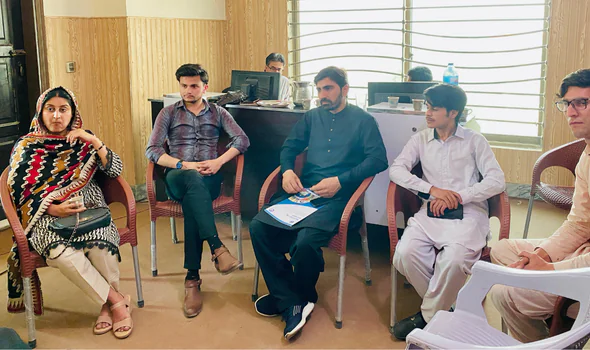
Skill development remains central to their mission. Through Amplify Asia, the team has finally been able to launch their long-dreamed-of youth internship program. The first batch of interns comprises five young women and three men who are receiving hands-on training in data collection, verification and storytelling. This initiative is a win-win: the interns are developing new digital and analytical skills in a part of the country where access to such training is very rare – especially for women – while Hazara Express is benefiting from their output, which contributes directly to the newsroom’s content pipeline.
Still, compromises exist. Sher Afzal admits that the tension with local advertisers, who sometimes expect immunity from criticism in exchange for business, tests their editorial independence. For now, however, he’s proud of the dialogue Hazara Express has started in the community and notes the invaluable contacts made through Amplify Asia, in particular with the coaches and peers across South Asia.
Hazara Express recently published a story about a woman running an old-age home in Mansehra that reached hundreds of thousands of viewers, exemplifying what this media is trying to achieve: journalism through people, not just about them.
This essay is part of a series highlighting the journeys of independent media organizations supported through MDIF’s media business capacity-building program across South and Southeast Asia, as they experiment with business models, strengthen resilience and adapt to challenging environments. Together, these stories contribute to a broader exploration of sustainability and innovation in independent media, which will be compiled into a full report following the release of the series.